
Selling a Car Without a Test Drive
Rapid experimentation turned assumptions into learnings
Executive Summary
Carlypso was an innovative used car dealership and a YC S14 startup. It was a direct-to-consumer sales model that purchased vehicles on the wholesale market for customers, delivering better vehicles at cheaper prices.
Despite these benefits, Carlypso struggled to overcome the inherent distrust from consumers around dealerships. How can we sell a car without a test drive? As Head of Product & Design, I was responsible for improving sales by representing the voice of the customer. As a lifelong auto enthusiast, I thought I had a good grasp of consumers' needs, but it turned out, I had a lot to discover.
Problem: How to sell a car without a test drive?
Used car dealerships are categorically distrusted by consumers. Carlypso was a new start-up with no reputation. Our office was a sparse warehouse in the industrial district of South San Francisco. While our model saved consumers money, it also required them to put down on a deposit and wait over two weeks to see their vehicle. Educating consumers about our process and overcoming this trust barrier presented a huge challenge to product & design.
Strategy: Iterate and learn through rapid Product Discovery consisting of:
- A/B testing
- Customer interviews
- Prototyping and user testing
- Redesigning the customer journey
Results: 3x sales via the Virtual Showroom
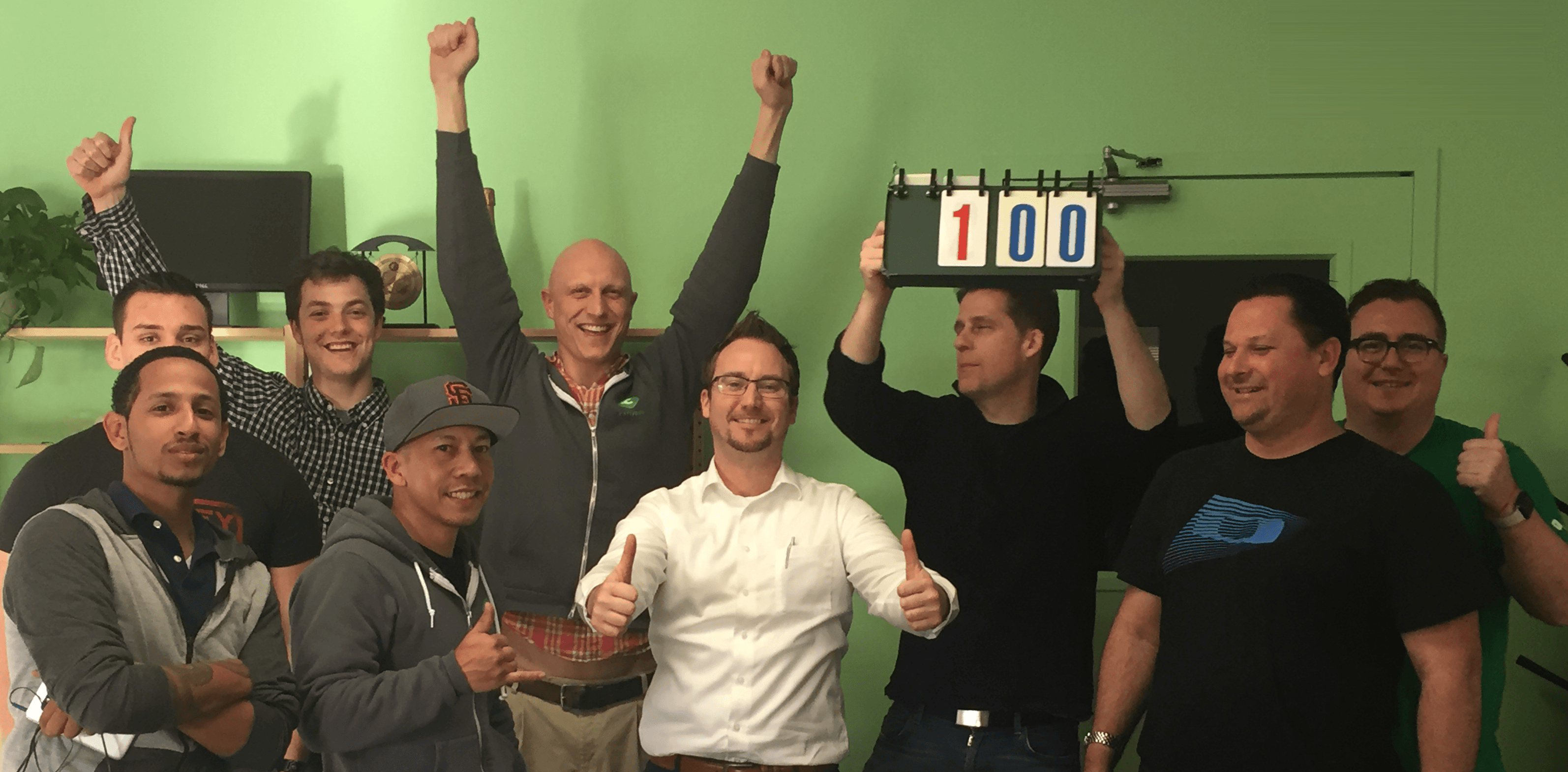
Launching in early 2016, the Virtual Showroom, combined with other site updates, increased inbound leads 5x and sales 3x. Sales peaked over 100 vehicles in April, representing over 3 sales per day from a 6-person sales team. This performance placed Carlypso among the top performing independent used car dealerships in the country, according to the National Independent Automotive Dealers Association (NIADA).
The Carlypso Model
Most used car dealerships fill their lots with vehicles purchased from wholesale auctions and sell those cars to consumers with a large markup. This model is very inefficient, and often ends up with consumers compromising on their desired vehicle and paying more than they should. In Carlypso's model, consumers told us what they wanted, and we searched for that vehicle across all the wholesale markets. In effect, we were virtualizing all the wholesale inventory and offering it directly to consumers. This provided several key benefits to consumers:
- Cheaper: Since we did not have overhead costs like inventory or a huge lot, our prices were on average $2,500 less than the market (~10%).
- Better Quality: The vehicles we selected for our consumers had a better condition rating than our competitors.
- Bigger Selection: Since we were searching among hundreds of thousands of vehicles, we could typically find exactly the car that our consumers wanted, with no compromise on color, options, or mileage.
Despite the cost and selection benefits of the Carlypso model, there were also significant challenges. Most obvious was that we were asking customers to commit to buying a vehicle before ever test driving it. Once they put down a deposit, we would go to the auction and acquire that vehicle on behalf of the customer. Then we had to ship, recondition, and prepare the vehicle for delivery. This was a complex and multi-week process:

We knew that our data was a competitive differentiator. Because we were scraping each wholesale auction site we had amassed a massive database of vehicle information, including comparative pricing and condition reports. So the challenge then became: How can we leverage this data with great design to build consumer trust?
Product Discovery
Our problem was clear, but since our sales model was new and unique, we did not know how to overcome the trust barriers and close sales. We kicked off a 6-month product discovery process to help guide our roadmap, focusing on several key questions to test against:
| Question | Test Method(s) |
|---|---|
| What does a customer want? | Gather customer data User interviews |
| How to explain Carlypso? | A/B test new messaging and content User interviews |
| How do customers shop? | Prototype new UX User test |
| What would help sales? | User ethnography Experiment with new sales tools |
What does a customer want?
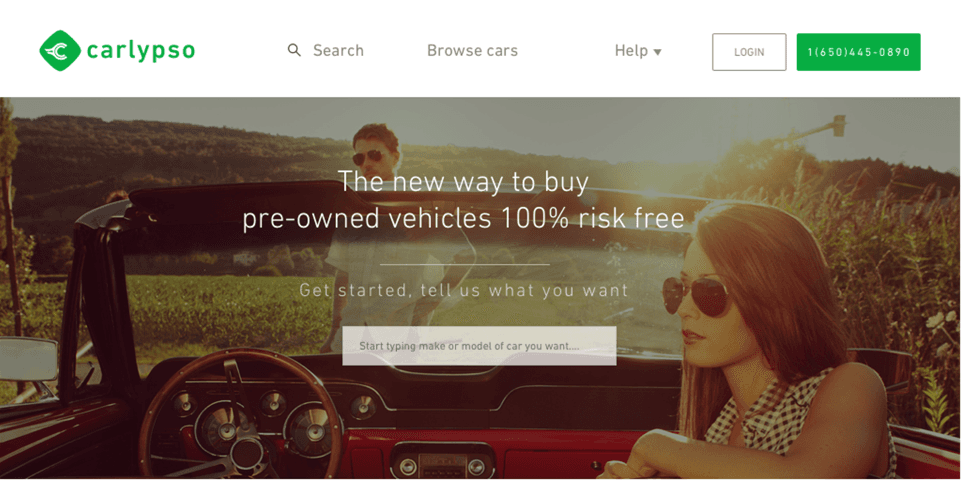
Our initial consumer website did not have very much information about the vehicles we had “for sale.” In fact, it looked similar to a traditional dealer website which caused issues with potential customers. We used stock photos for inventory listings, and due to technical bugs they never seemed to work right. This frustrated customers further, but can you blame them?
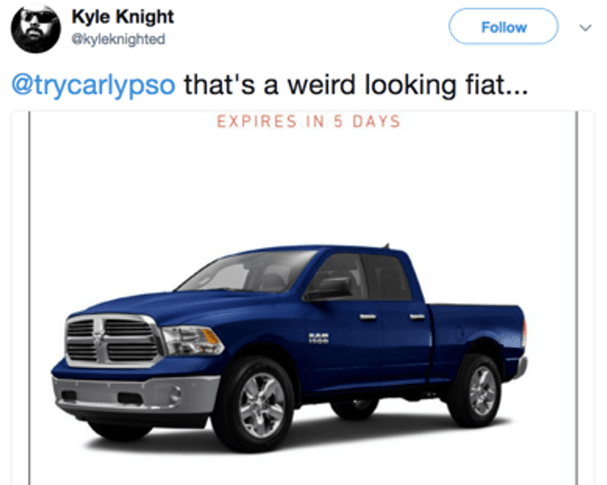
We decided to start our discovery process with a clean slate. We dropped the listings UX altogether and replaced the entire site with a simple open submission form: Tell us what you want and we'll go find it. As you might expect, this had abysmal conversion. However, the use of an open submission form had the benefit of gathering data on exactly what the customer was looking for, most importantly they provided it in their own words:
- “2012 Miata with low miles”
- “Off lease c class silver”
- “Nissan leaf for my daughter”
How to explain Carlypso?
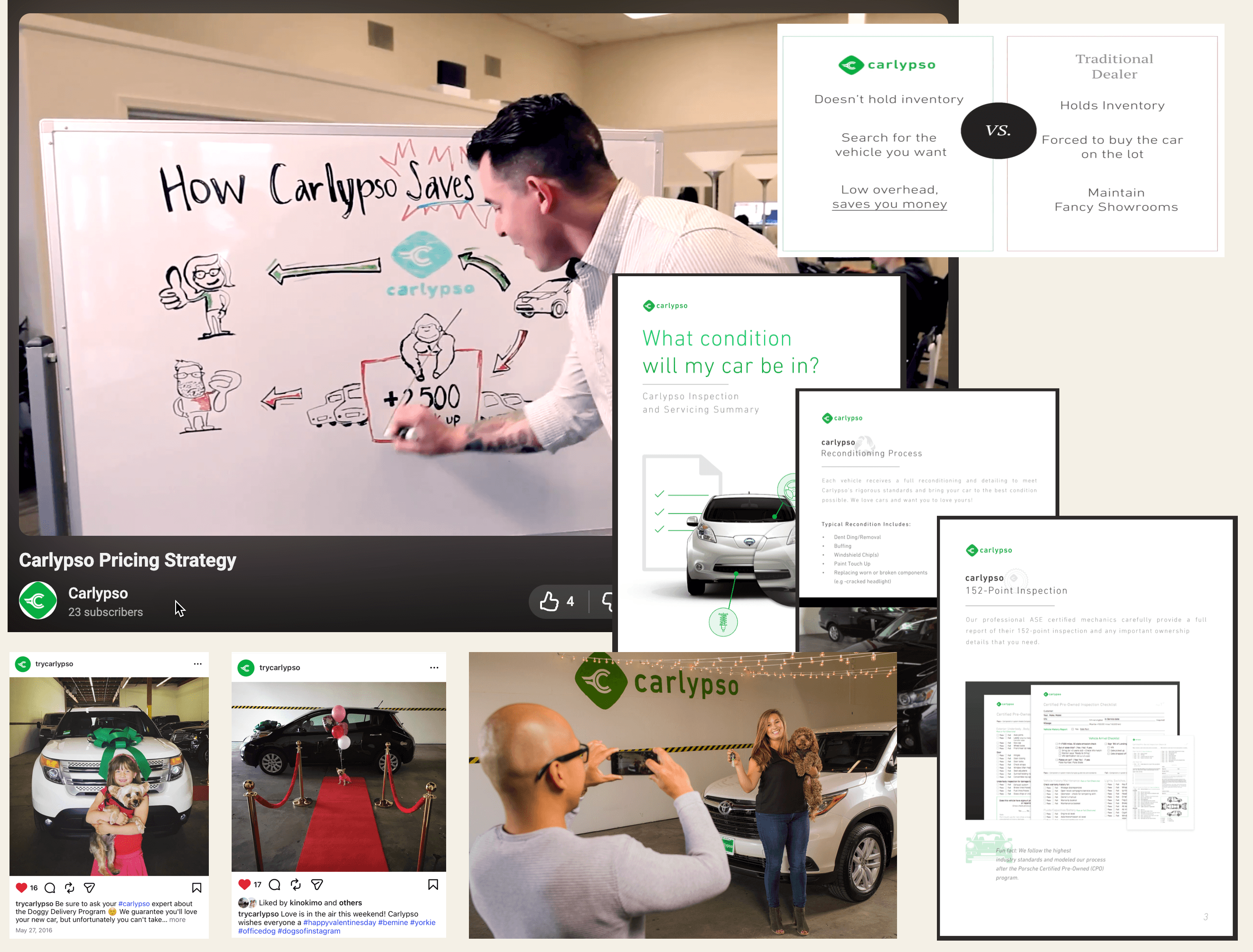
Before we dived in on any new product or design prototyping, we wanted to learn how to message and communicate our value proposition to consumers. If we figured that out, it would be straightforward to build our new UX around that messaging. So we started experimenting and A/B testing new content to convert the customer on our process:
- New messaging on homepage
- Boosting a social media presence
- Creating informational brochures & videos
- Adding a new “How it works” page on the site
We also interviewed customers pre- and post-purchase to get qualitative feedback. One of the biggest surprises during this was how many customers mentioned our instagram when picking up their cars. “I saw the dogs on your instagram. Can I take a picture with my car?” Reflecting, this helped the dealership look more personable which in turn built some trust. Other strategies did not work as well, and I wish I could scrub the internet of our early explanatory videos.
How do customers shop?
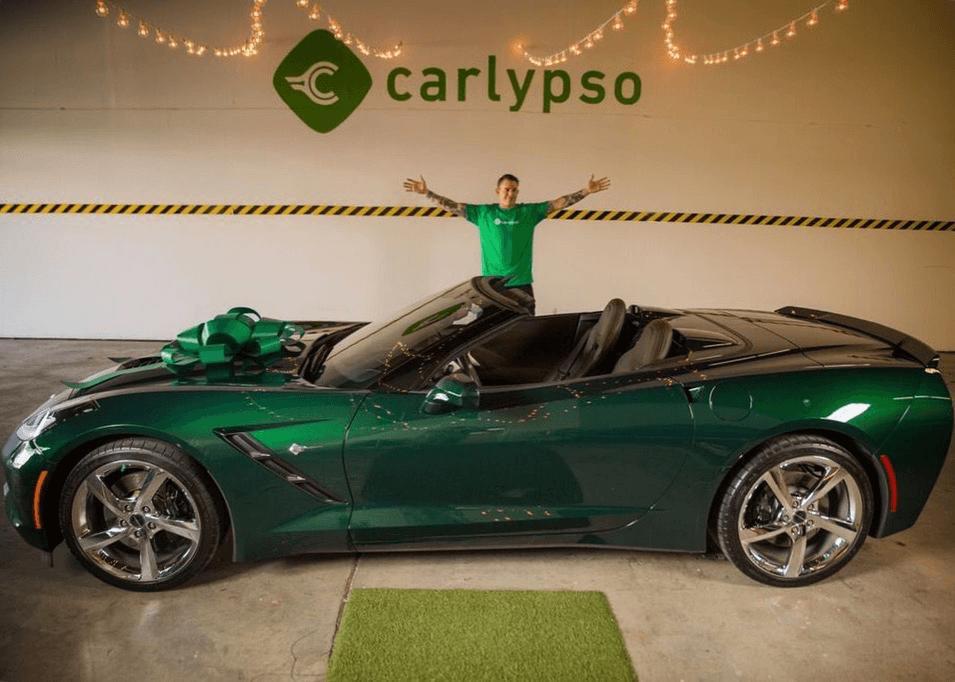
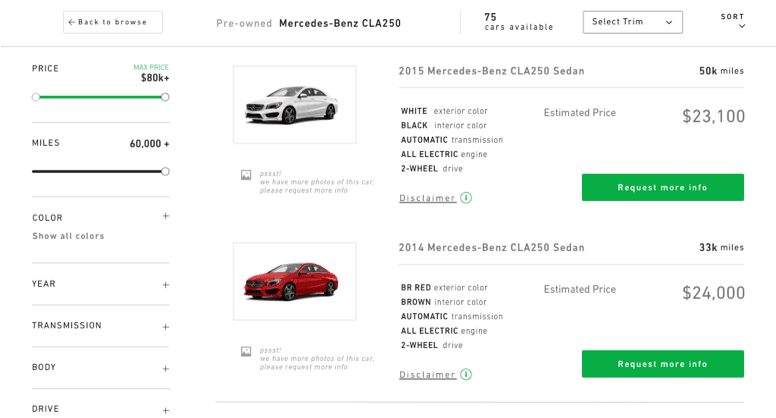
We took these early test results to start prototyping a new browsing product with listings on our site. We still had no pictures, but we fixed our stock imagery and we started experimenting with other image solutions. For example, while we could not provide images of the actual vehicle the consumer was purchasing, we could show them a gallery of Mercedes we recently had delivered to consumers. This involved me going into our warehouse, snapping some pics, labeling them, and uploading them to our site. While this is not a scalable method, it did help demonstrate to customers that we were a legitimate dealership that was moving vehicles. We also added additional categories and search capabilities based on previous learnings so users could narrow in on their ideal vehicle.
What would help sales?
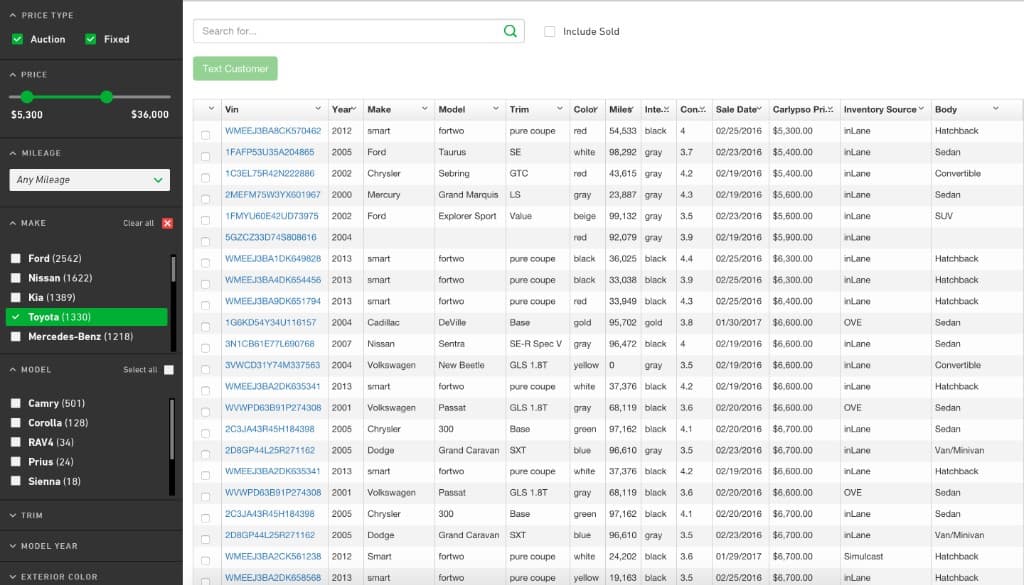
The prototype listings UX, combined with improved messaging, helped to build some momentum with inbound leads, but it was still taking sales too long to close. We tried some out-of-the-box thinking and allowed the salesmen to directly screen share with customers. Product, design, and even some engineers sat in on these sales calls, effectively turning every sales call into an user ethnography.
Screensharing enabled consumers to see everything in our inventory and full vehicle details via our internal inventory management system we called SalesBooster. We thought ultimate transparency would increase trust and cut down on the back-and-forth with the salesmen, but we actually found out exactly the opposite. Customers did not trust the transparency. If they saw a small scratch, they wondered what “real issues you were hiding.” When they got a “no-haggle price,” they would still try to negotiate. Understanding this customer psychology was extremely helpful to guide the products we ultimately created. Screensharing actually hurt conversion, but gave us valuable take-aways. Often in failure, we learn the most.
Key Learnings
This rapid testing and experimentation occurred over a 6 month period and gave us several critical discoveries about our customers that ultimately drove our product design:
| ASSUMPTIONS | PSYCHOLOGY | DISCOVERIES |
|---|---|---|
| More selection is good | Paradox of Choice | Too many choices overwhelms customer |
| Full transparency on condition | Negativity Bias | Admitting any fault creates doubt |
| Cheapest price up front | Transaction Utility | Customers want to negotiate a deal |
| Sales people sell cars | Halo Effect | Cute dogs sell cars |
We started with a set of assumptions that felt logical, but didn’t match how customers actually behave. More selection didn’t help; it created paralysis. Full transparency didn’t build trust; it amplified doubt. And the lowest upfront price didn’t convert; it removed the sense of control customers get from negotiating. In reality, customers weren’t optimizing for information or efficiency: they were reacting to cognitive biases and emotional cues. Recognizing this shifted our product design from simply presenting better options to designing an experience that aligned with how people actually make decisions.
Solution: Designing the Virtual Showroom
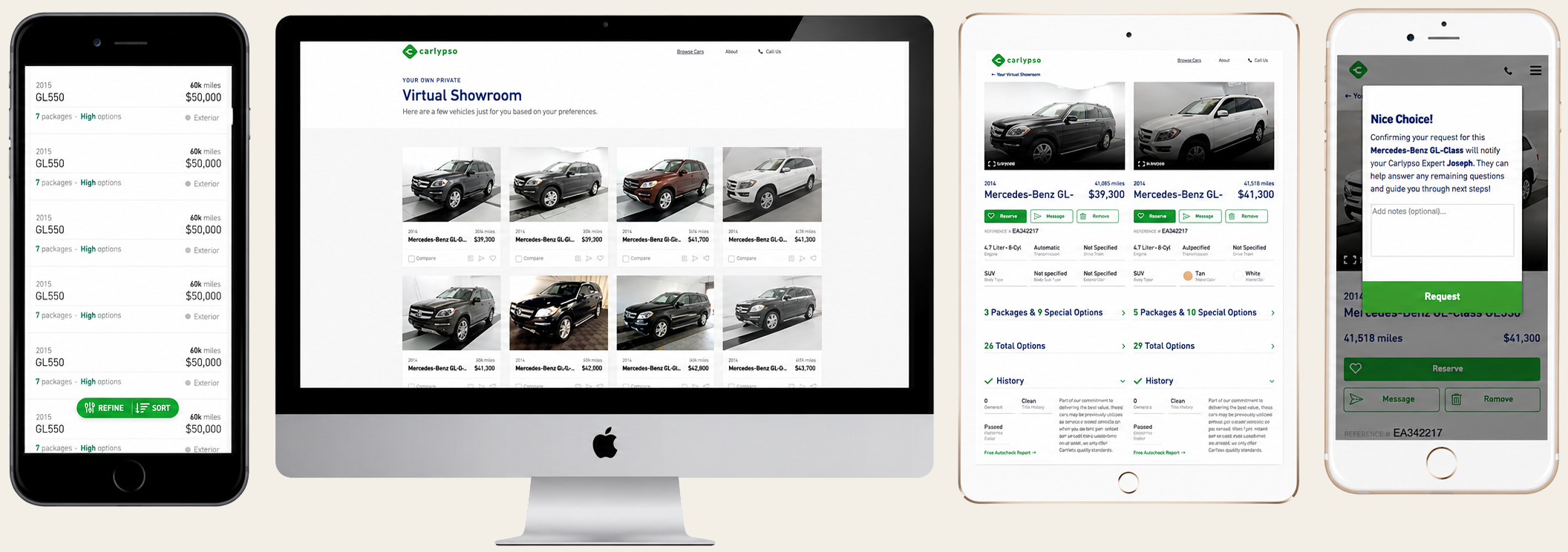
We brought together all of these product discoveries to create the Virtual Showroom. Our goal was replicating the sales experience online, without the salesman. The Virtual Showroom was designed to solve three customer needs:
- Help customers find the car they want
- Build trust that it’s a good car
- Demonstrate they are getting a deal
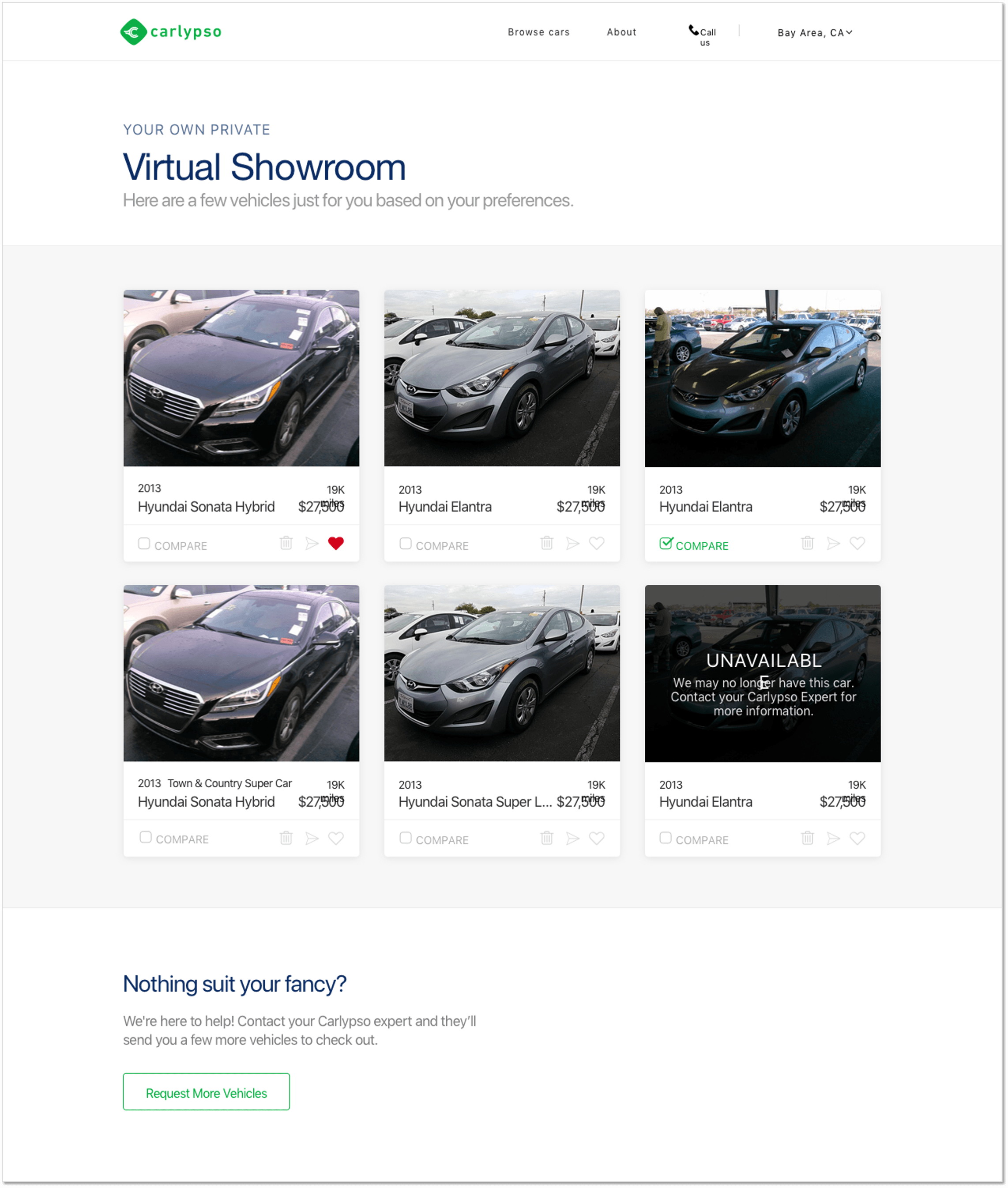
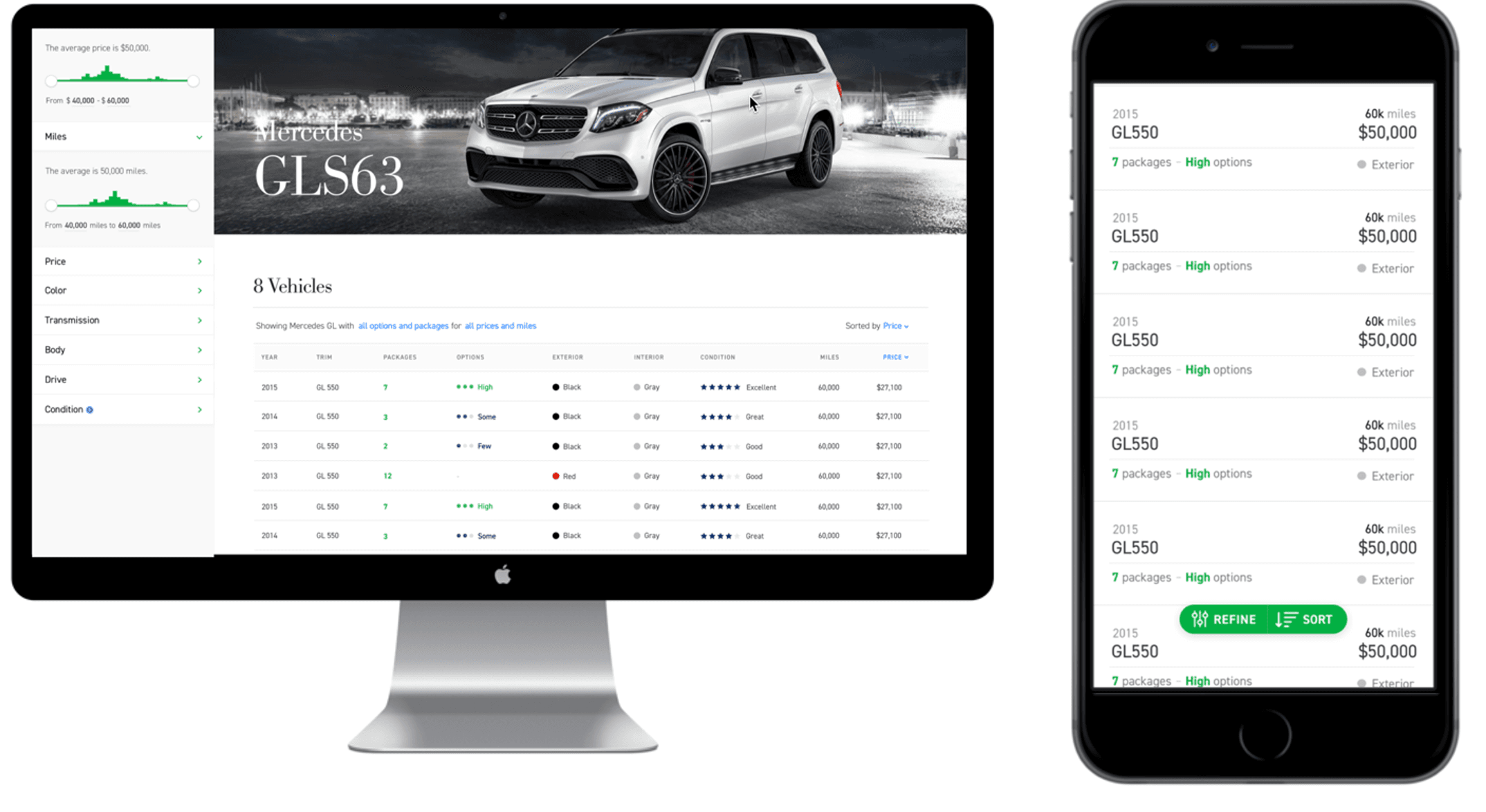
1) Find the Car They Want: New Listings
We took the lessons learned by screen sharing the SalesBooster inventory management tool and applied that to a full revamp of listings, focusing on helping search through the thousands of vehicles to pinpoint a few to add to their Virtual Showroom. In effect, we were giving our customers the same tools our sales people had, just wrapped in a more appealing visual design. We also provided information an dfeedback to set expectations during search, creating visualizations similar to Kayak to narrow in on best mileage and price.
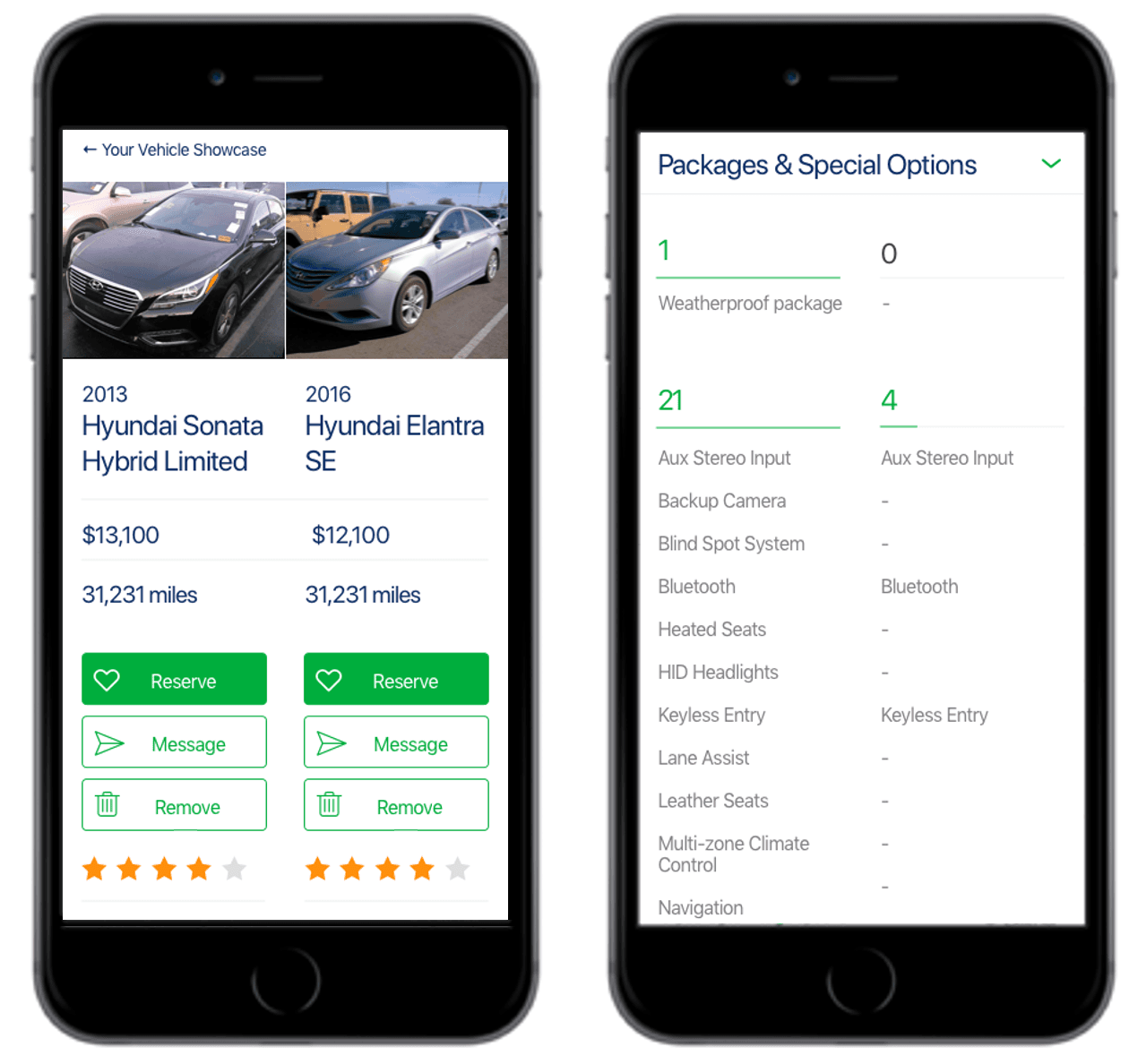
2) Build Trust: Comparison Tool
The second component of the Virtual Showroom was a vehicle comparison tool, which became our highest-performing UX in terms of both conversion and decision efficiency. It allowed consumers to compare two vehicles side-by-side in a streamlined experience, replacing what was previously a fragmented, verbal process often handled by sales teams over the phone. User testing confirmed that limiting comparisons to two vehicles created the clearest and most actionable experience. Internally, we referred to it as our “Tinder for Cars.”
Key capabilities included:
- Standardized visual comparisons – We curated and normalized imagery across auction houses, aligning equivalent angles so users could directly and intuitively compare vehicle condition and features side-by-side.
- Structured information hierarchy – Rather than presenting options as flat lists, we reorganized vehicle data into a clean, scannable layout that highlighted differences clearly and reduced cognitive load during comparison.
- Embedded sales engagement – Users could message our team directly within the comparison interface, enabling real-time questions without breaking the browsing flow.
- VIN-based cross-market intelligence – A powerful insight from UX testing was users cross-shopping vehicles at competitors like CarMax. Because many of these vehicles originated from the same auctions, we could surface historical VIN data—including condition reports, auction pricing, and prior sale context—allowing users to make highly informed comparisons.
- Behavioral analytics for intent tracking – We captured interaction data within the comparison flow, giving us visibility into which vehicles and attributes users were engaging with most, and where decision friction occurred.
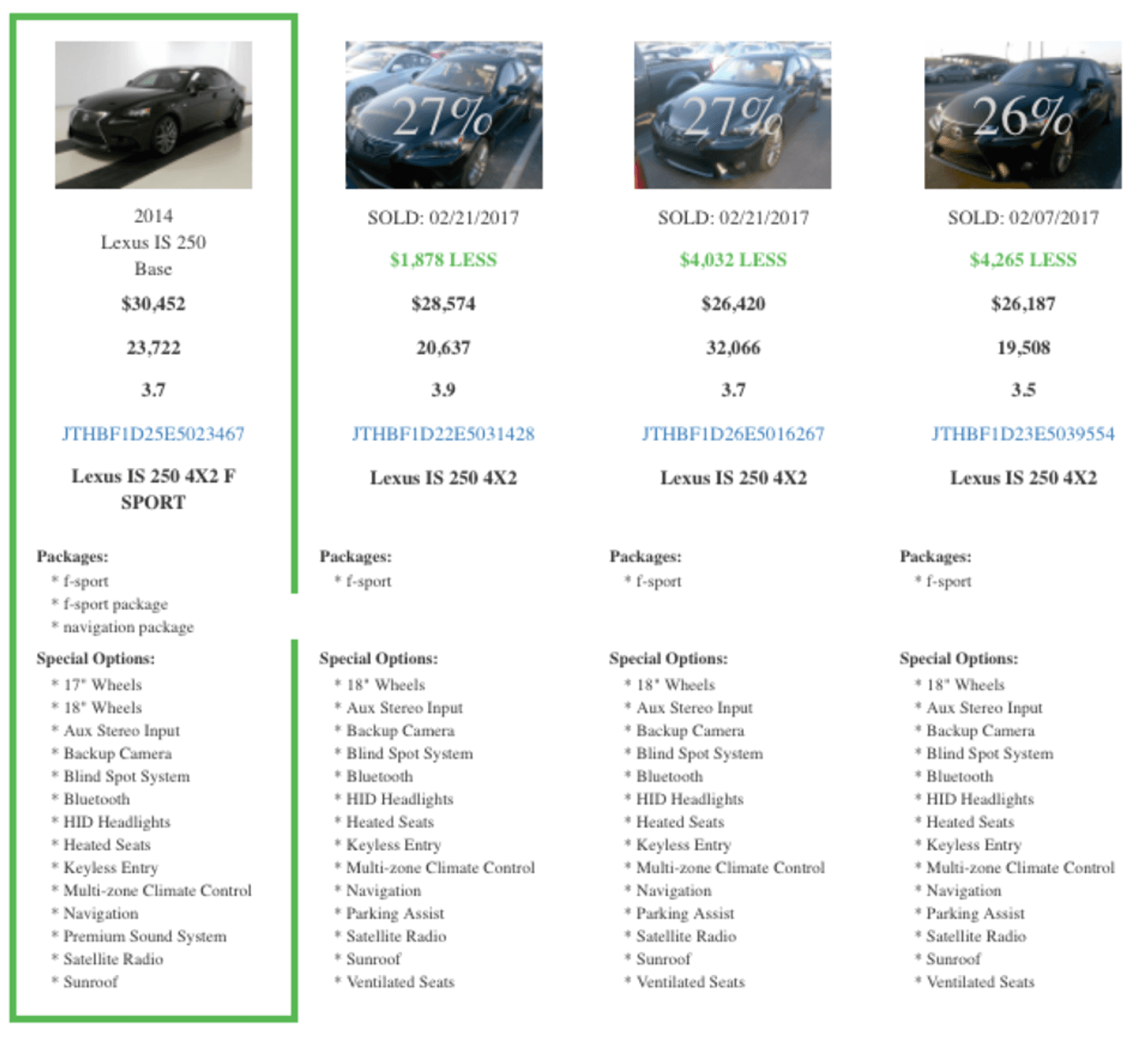
3) Support the Deal: Nearest Neighbor Pricing
The final component of the Virtual Showroom was the Nearest Neighbor Pricing Tool, which remained in alpha and was never fully productized. Built using machine learning and data science models, it surfaced recently sold, highly similar vehicles and generated pricing predictions to help customers evaluate fairness and tradeoffs across options, colors, mileage, and condition.
While it never launched broadly within the Virtual Showroom, it proved highly effective in sales-assisted scenarios, particularly with customers on the fence. By automating the comparison of comparable vehicles and predicting wholesale pricing with associated confidence levels, it enabled clearer, more transparent pricing discussions and made value positioning significantly easier. It gave sales teams a data-backed way to build trust and accelerate closing conversations.
Results
Launched in early 2016, the Virtual Showroom and supporting site improvements fundamentally changed how customers discovered, evaluated, and purchased vehicles with Carlypso. Rather than browsing static listings, users were now able to actively compare vehicles, understand pricing context, and move through the decision process with far less friction. This shift had a direct impact on business performance and sales efficiency.
Key outcomes included:
- 5x increase in inbound leads driven by improved site messaging
- 3x growth in total sales following the rollout of the Virtual Showroom experience
- 27% improvement in sales efficiency due to internal sales tool improvements
- Peak volume of 100+ vehicles sold per month
This performance reflected a broader shift from a traditional, sales-led used car operation to a more product-led buying experience, where digital tools increasingly carried the burden of education and comparison before a sales interaction ever began.
Reflections
Looking back, our original vision was to build the “Amazon of car buying,” and while the company’s trajectory was ultimately shortened by a strategic exit, Carlypso remains the most complete example of product discovery in my career. Despite being a lifelong automotive enthusiast, the work repeatedly challenged assumptions about how people actually shop for cars. Many of the most impactful product decisions came not from expertise, but from testing those assumptions directly with users and following the behavior data wherever it led.
Over less than two years, Carlypso sold more than 2,000 used vehicles. The strength of the predictive pricing and marketplace intelligence systems we built ultimately attracted the attention of a larger, more capitalized automotive retailer, and Carlypso was acquired by Carvana in the summer of 2017.
Next case study
Personal Design Projects