
Doubling Conversion by Redesigning the User Journey
Building trust in auto repair while scaling design thinking
Executive Summary
RepairPal is the largest online auto repair marketplace in the US, with more shops than Pep Boys, Firestone, or Jiffy Lube. Since shops pay a monthly subscription fee to be listed in the RepairPal directory, it is critical to drive consumer demand through the marketplace. In 2019, we observed value through the website declining, threatening our recurring subscription revenue.
As VP of Product and Design, I was responsible for improving the performance of RepairPal.com. After analyzing key metrics, and performing extensive user research, we identified a large trust gap with our users prompting an immediate redesign of our user journey.
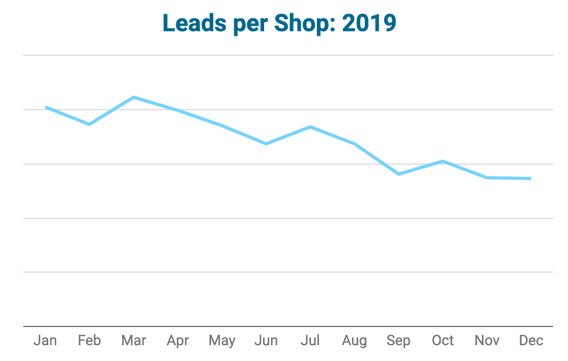
Problem: Marketplace value was declining with leads trending down 30%
Prior to 2019, RepairPal did not track full-funnel metrics like site conversion, and instead focused on vanity metrics like pageviews. Additionally, the company had two designers who were treated as pixel pushers: “Change the color of this button,” or “add a bunch of words here” or “make this pretty” were all too familiar examples of how design was seen as task executors, as opposed to problem solvers. This resulted in RepairPal neglecting their users and leads declining over time.
Hypothesis: Modern UX/UI will improve conversion
The RepairPal.com user experience had not been updated in many years, and user research confirmed consumers did not trust the site. Armed with a new Design Process, a better understanding of our user journey, and improved site analytics, we believed that a site redesign would build trust and improve conversion.
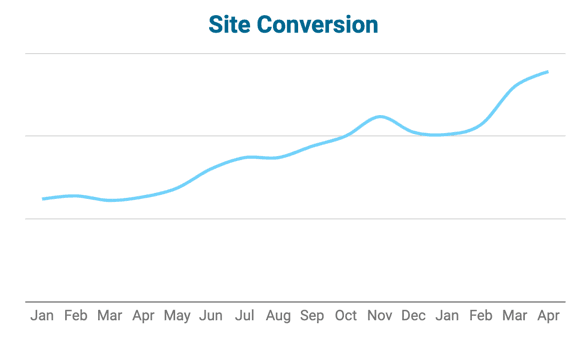
Results: Site conversion more than doubled in under 18 months
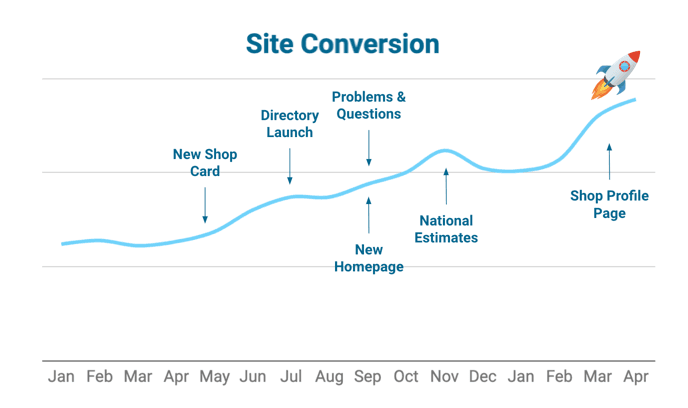
Through extensive user research and rapid A/B testing, every major redesign effort yielded substantial improvements to site metrics, driving a 2.5x increase in overall site conversion. Individual UX highlights included:
- 44% more appointments booked from directory
- 34% more appointments booked from shop profile pages
- 12x increase in visits to the estimator
- 2x conversion of homepage
Creating a Strategy and Validating Hypothesis
As with every major project, we started with some good old fashioned brainstorming! I purposely made this a cross-functional effort, sharing our challenges in conversion and soliciting ideas from across the organization. Being a small company of 60, involving everyone at this early stage not only helped with ideation, but also aligned the company on the problem and made them a stakeholder in the results. When it came time to celebrate the team's achievements, the entire company was supporting us.
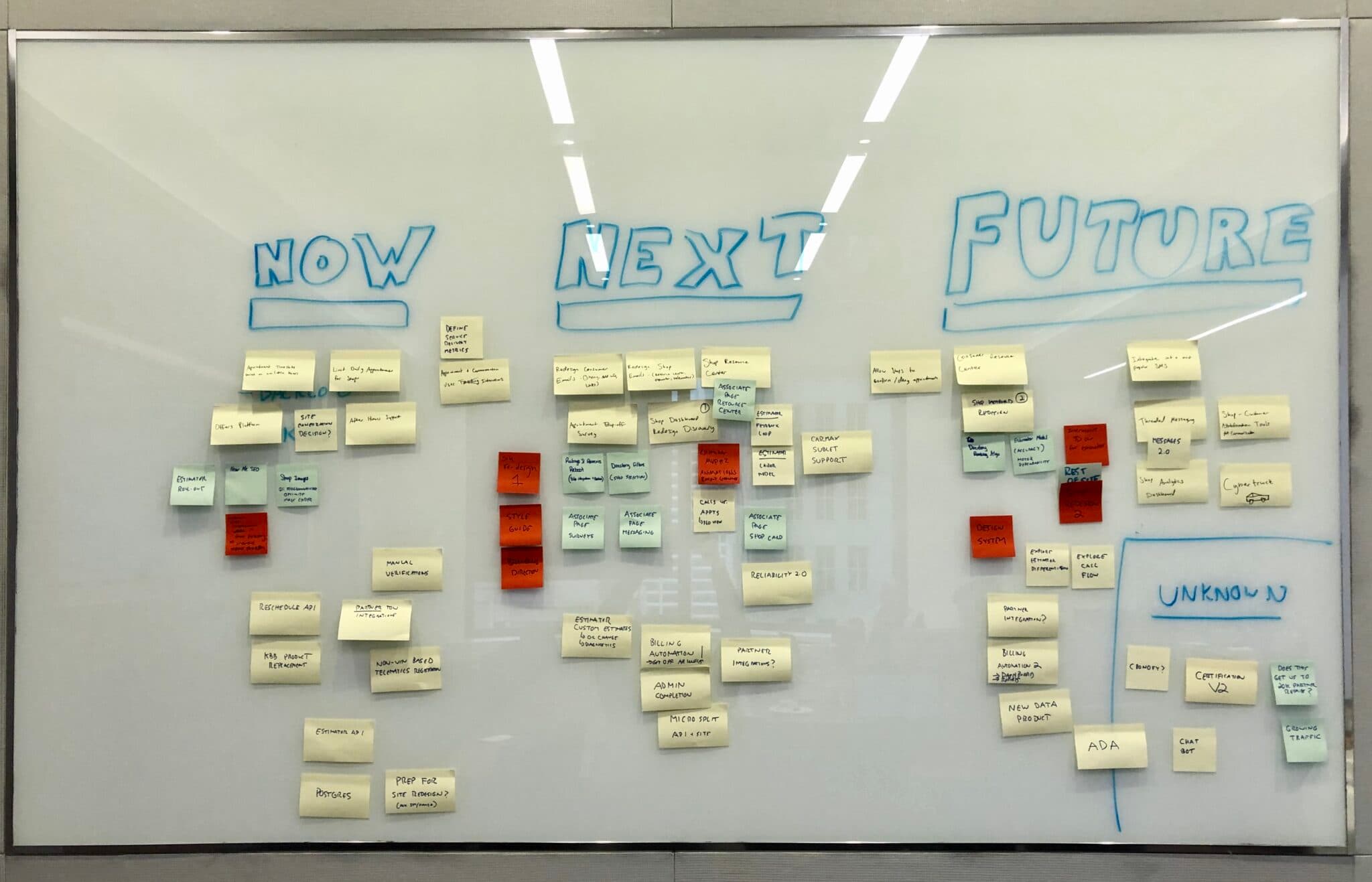
There is never a shortage of ideas at startups. But where success often breaks down is with prioritization and execution. So our next step was using card sorting techniques to map each idea to potential impact and complexity to implement. This drove our strategy and roadmap for 2020:
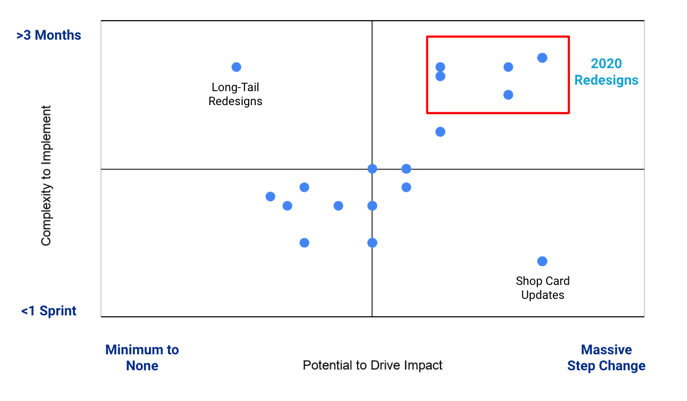
We spent the next several months rapidly testing and validating these ideas. Ultimately, the biggest win of Q1 was establishing this rapid testing methodology and creating data-driven feedback loops. In Q1 2020 we ran over 8 A/B tests on the site. That is a major test each sprint. Previously, we had run one test per quarter. This was a major shift in the team's approach and helped to refine our strategy and provide quick feedback to our stakeholders. Several executives were convinced that simple color & copy changes would fix all issues, but test results showed otherwise:
- Button Tests – Changing color or position of the main CTA's did not substantially impact conversion.
- Homepage Copy Test – Changing copy alone did not change user behavior downstream in the funnel.
- Shop Card Visual Update – A quick visual refresh of our directory shop cards yielded an immediate 7.6% boost in conversion.
Observing the biggest gains in visual updates helped us to validate our hypothesis that UX/UI would drive conversion improvements. This gave us the necessary proof points to invest additional time and resources to larger redesign efforts.
Site Redesign
Phase 1: Directory Visual Redesign
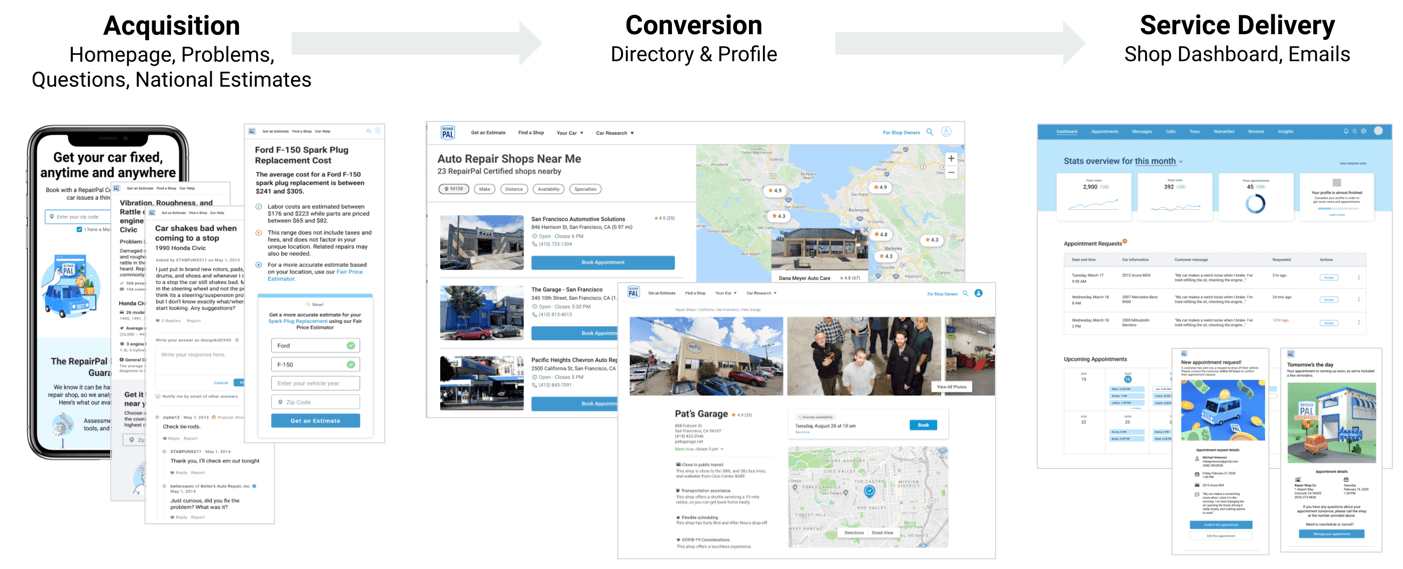
Armed with a validated hypothesis and a better understanding of our customer journey, we decided to tackle the most important user experience on our site: The Shop Directory. The directory is where a majority of our users convert, so it was the clear starting point. Additionally, marketplace directories are common user experiences, so there were a lot of examples and UX research to leverage. There were less "unknowns" with the directory, and it represented a more visual challenge which was helpful being just myself and one visual designer on the team.
We performed several rounds of user interviews to better understand expectations and refine our designs. We found users did not trust the RepairPal site, to the point where they would call our shops and ask them:
"Are you a real shop? I found you on this random site and don't know if it's legit."
As hard as it is to hear feedback this direct, it's priceless in terms of helping craft our design goals:
- Familiar Marketplace: Model our UX after other common marketplace directories in line with consumer expectations.
- Modern UX/UI: Users primary reason for selecting a shop is location. Increasing the size and interactive capabilities of the map was core to the redesign.
- Consumer Focused: The majority of our converting users were women, who identified exterior photos being important. We contracted with a graphic designer to find and format new exterior photos for all shops to feature on shop cards.
- Mobile Optimized: Over 70% of our traffic is mobile. Having a mobile-first design would help ensure we deliver the best UX for our users.
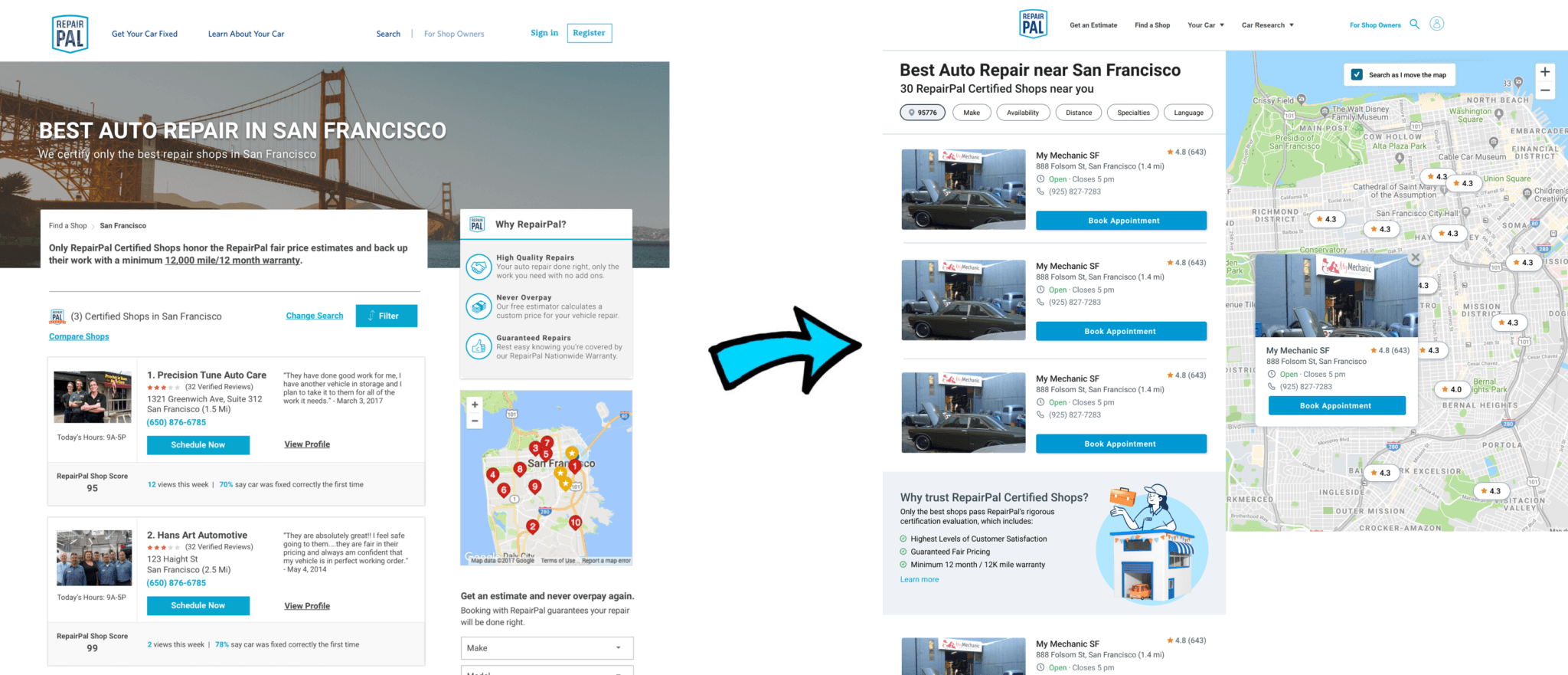
The new shop directory was an 8-month process: Three months of research & design, followed by four months of development, and a month-long phased launch in July. The results of the redesign demonstrate we achieved improved conversion but also a massive increase in trust:
- +14% Total Leads
- +44% Appointments
- -4% Calls
The 14% improvement in total leads was the first double-digit increase in conversion the company has ever observed. The impressive 44% increase in booking appointments showcased the improved trust and credibility the redesign had with users. We attribute the 4% decline in calls as also a trust proof point, eliminating those confused customer calls. Our first major UX/UI redesign proved highly successful and it set the momentum for future work.
Phase 2: Directing Users Through the Funnel
The directory redesign was a big bet that proved worthwhile. With our main conversion page performing better, we then moved on to higher traffic acquisition pages higher in the customer journey that we knew could benefit from improved UX/UI. We also knew that if we could direct more traffic from these pages to our directory, it would boost downhill conversion and leads to our shops. We prioritized our work based on the most popular acquisition pages on the site:
- Problems
- National Estimates
- Questions
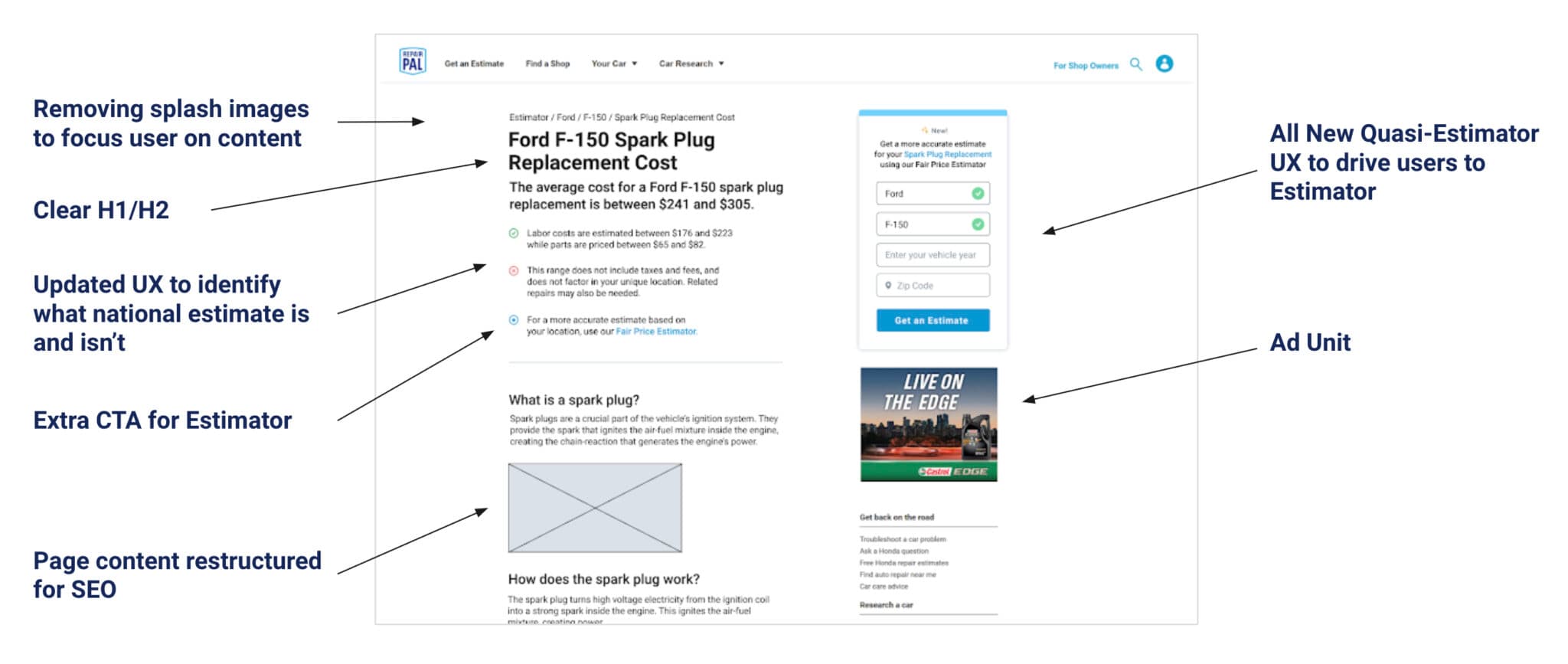
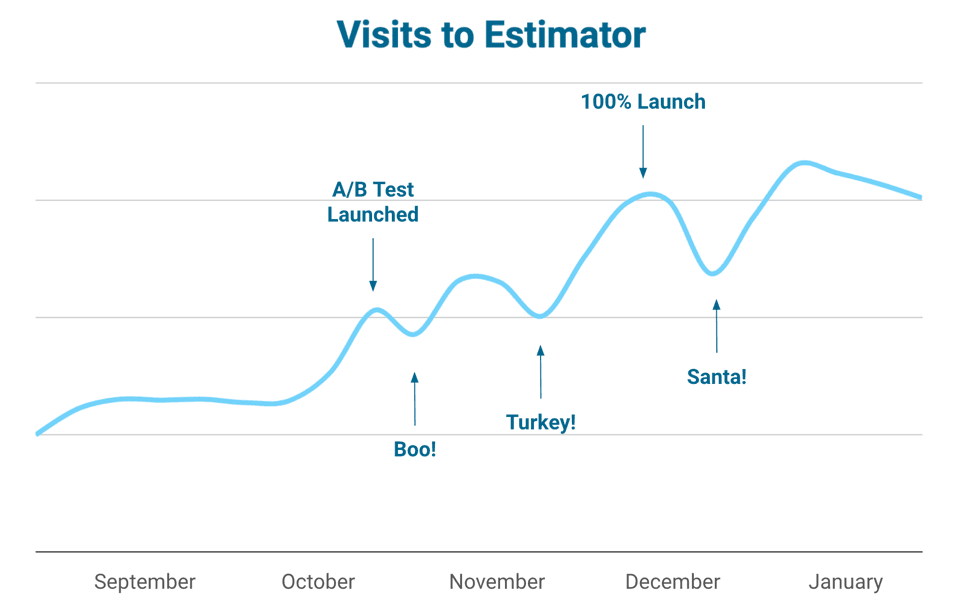
The National Estimates proved to be the most successful launch for us in 2020 thanks to strong collaboration between UX Research and Design. Millions of users visit these pages every month from organic keywords like "Ford F-150 Spark Plug Replacement Cost." UX research conducted several on-site surveys in addition to user interviews to help understand the key pain points with the existing page. The resulting UXR insights and redesign drove a 12X increase in visitors to the estimator from these pages and a 2X increase in downstream leads generated.
Phase 3: Refining Messaging on the Homepage
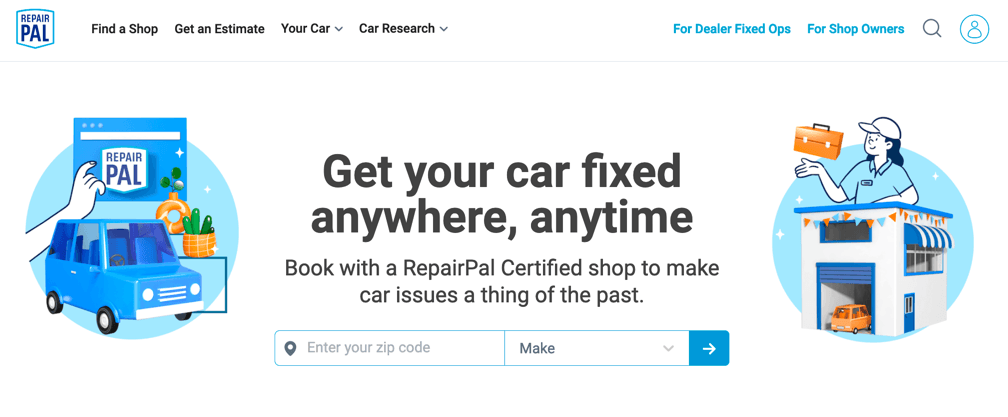
At the same time we were redesigning key acquisition and conversion pages across the site, we also phased in a redesign for our homepage. During user testing we observed users going to the RepairPal homepage to learn more about the company. Having an outdated homepage hurt credibility and created confusion. Improving the visual identity of the homepage started to bring some design consistency to our site and helped reinforce our consumer value proposition. We performed a few rounds of user interviews and ran several A/B tests to refine the messaging. This led to two very interesting findings that drove the visual updates to the page.
First, we found that messaging that pushed users to "find a shop" was too direct. Consumers did not come to RepairPal looking for a shop, they came to RepairPal to get help with their car problem. So we re-framed the main messaging to respond directly to this: RepairPal helps you get your car fixed.
Second, we created brand messaging that focused on our process as opposed to generic marketing phrases. "Why should I trust a RepairPal shop?" is feedback we would often get in user interviews. Our existing messaging answered this question with marketing lingo such as "high quality" and "never overpay." During user interviews, consumers wanted to know what was involved in certification, rather than the sales pitch.
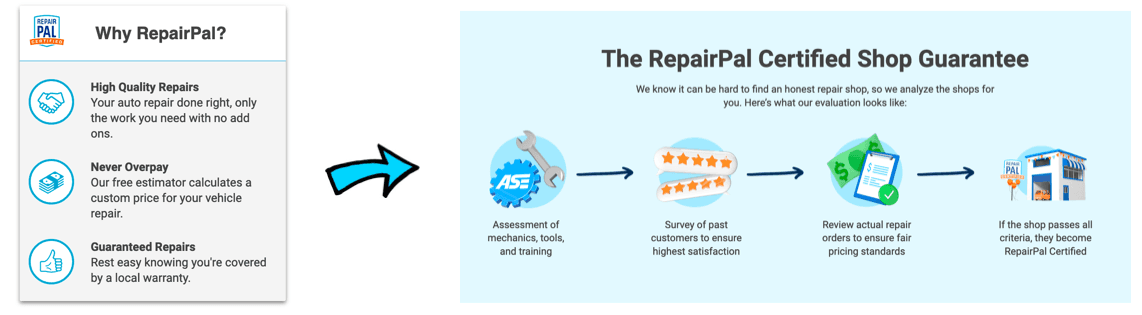
The iterative A/B tests resulted in improvements more than doubling conversion of the homepage:
- A/B Test 1 – Header visual update: +56%
- A/B Test 2 – "Get it Fixed" copy update: +6%
- A/B Test 3 – Full page update with Why RepairPal update: +23%
Phase 4: Completing the Journey with Shop Profile Pages
In Q1 2021, we completed the final major phase of the site redesign with the launch of all-new Shop Profile pages. If the directory helped users discover a shop, the profile page had to help them feel confident enough to contact one. This made it one of the most important trust-building surfaces in the full conversion funnel.
The shop profile page redesign benefited from a full UXR process led by lead researcher Shreya Venkatesen. She combined behavioral analysis, surveys, and card sorting; culminating in an all hands presentation styled after Netflix that was unanimously loved by the company. This presentation served as a turning point for how the organization viewed research. Design has transitioned from “pixel pushers” to being championed by the CEO.
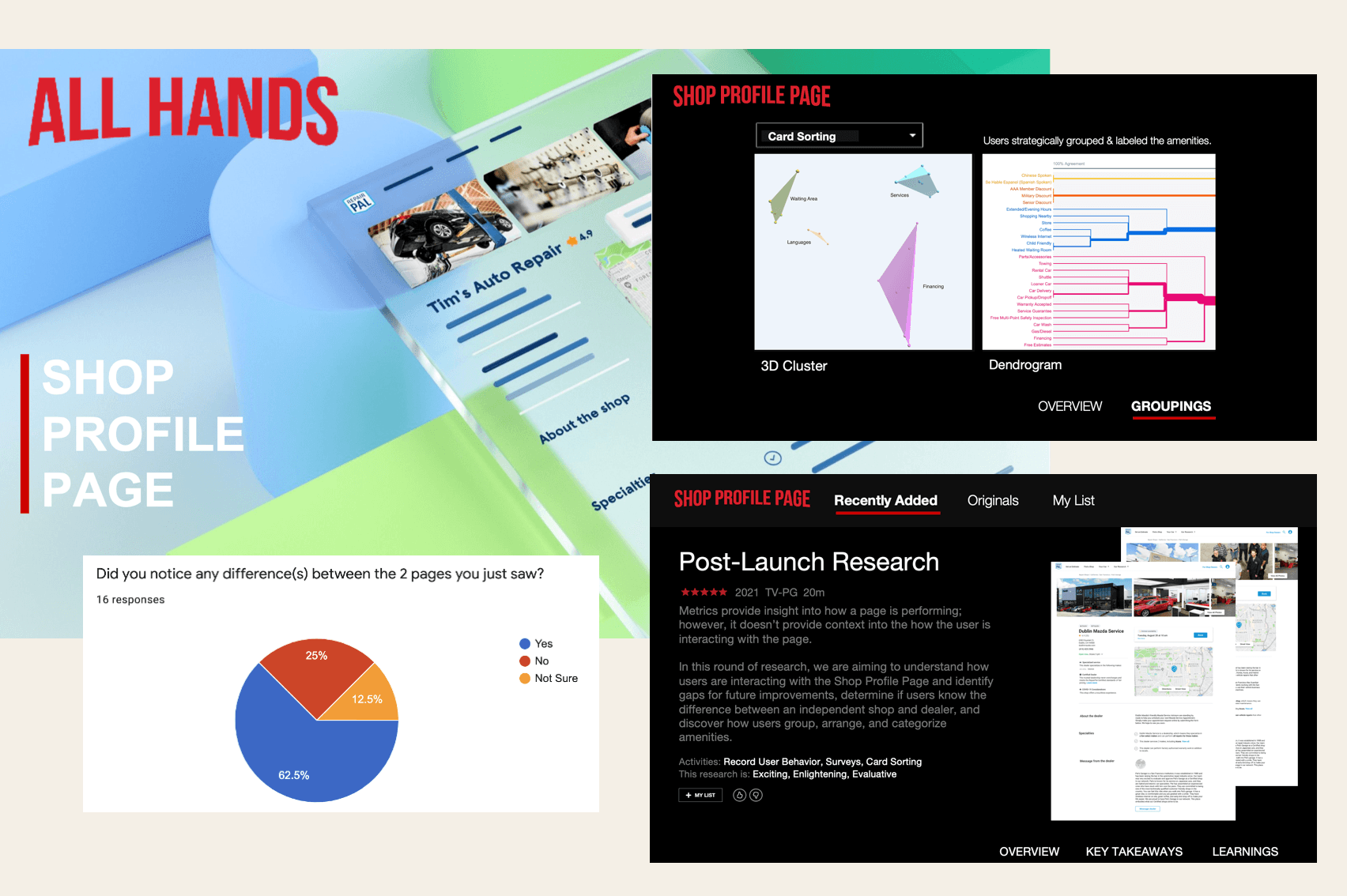
We wanted to understand how users actually interacted with the page, what information they cared about most, and where the experience still created friction. The research showed that users primarily came to the profile page for three reasons:
| Customer Needs | New Feature |
|---|---|
| Learn what the shop offers | Customer-orientated highlights & amenities |
| Decide whether to book | Improved shop availability, hours, and location |
| Evaluate quality and credibility | Adding search to shop reviews |
This helped us focus the redesign on the information that mattered most in the decision-making moment. We introduced several key improvements, including consumer-orientated highlights, improved shop availability, and the ability to search through reviews. We also learned that users valued amenities that reduced uncertainty and made the experience feel more convenient, helping us to prioritize hierarchy on the page.
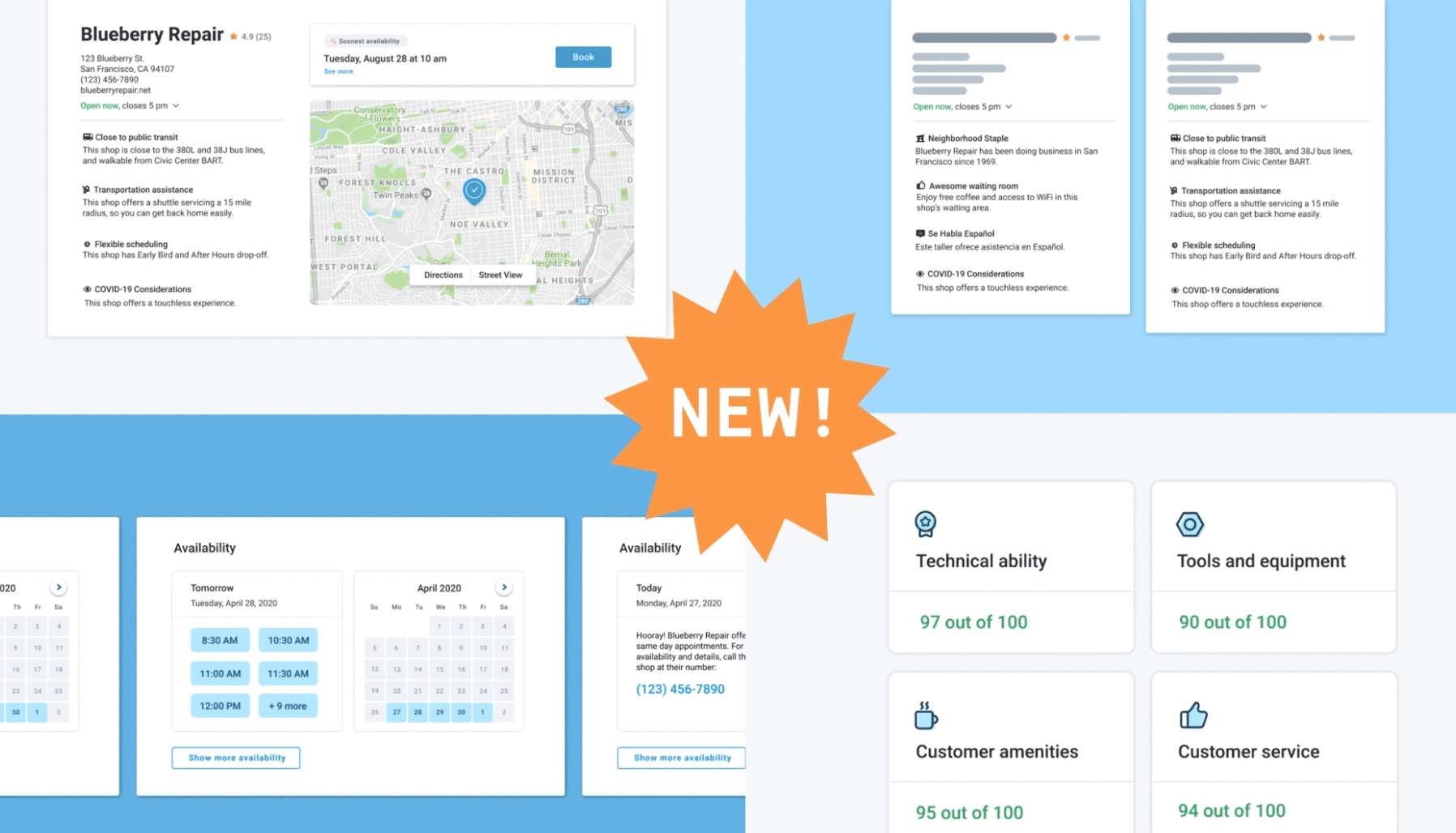
Post-launch feedback validated the new direction. Users described the page as clean, informative, comprehensive, and easy to navigate. They were able to find the information they needed without hunting for it, and the structure made it easier to compare shops and build confidence in their decision.
Most importantly, the redesign delivered measurable business impact:
- +24% total contacts
- +34% appointments generated
The Shop Profile redesign completed the broader site transformation by strengthening the final step in the funnel. After improving discovery, acquisition, and messaging across the site, we created a profile experience that better answered the user’s core question: “Can I trust this shop enough to take the next step?”
Results
Our redesign strategy more than doubled site conversion in under 18 months, reversing a 30% decline in leads and restoring value to the RepairPal marketplace.
Key outcomes included:
- 2.5x site conversion growth in under 18 months after shifting from ad hoc changes to a research and testing redesign strategy.
- 8+ A/B tests in one quarter, up from roughly one test per quarter before, establishing a much faster product learning loop.
- 44% more appointments booked from the new directory experience, indicating a meaningful increase in user trust and purchase intent.
- 34% more appointments booked from the new shop profile page, highlighting the benefits of running a full UX research process.
- 12x increase in visits to the estimator from redesigned National Estimates pages, helping move more high-intent users deeper into the funnel.
- 2x conversion of homepage as messaging shifted from generic marketing language to clearer, trust-building value propositions.
Taken together, these efforts created compounding gains across the funnel and established a strong foundation for continued improvements through design.
The clearest proof point came from the Shop Directory redesign, our most important conversion surface. After launch, total leads increased 14%, appointments increased 44%, and calls declined 4%. That decline in calls was meaningful too. It suggested users had more confidence in the experience and needed less reassurance before taking action.
These gains were not the result of one isolated redesign, but of a broader shift toward research-led product development. We moved from infrequent, opinion-driven changes to rapid experimentation, running more than eight A/B tests in our first 3 months. That helped us quickly identify which ideas actually influenced behavior and where to invest more deeply in UX and visual design. The shop profile page redesign also proved the value of UX research in defining product strategy, further strengthening RepairPal’s design process.
Reflections
This project improved more than site conversion. It improved how the organization made product decisions. When we started, design was still treated as an afterthought and many ideas were driven top-down. By introducing full-funnel analytics, rapid experimentation, and regular UX research, we created a more objective and collaborative way to product design. Ultimately, this approach became our design process and how we developed new products.
Just as important as process and results, the work helped build a stronger product and design culture inside the company. Weekly performance updates and company-wide readouts made the results visible, aligned teams around shared goals, and gave the organization a better understanding of how marketplace supply and demand worked together. We were not just improving conversion. We were building the internal muscle to solve problems with research, design, and data.
Next case study
Selling a Car Without a Test Drive